

Dubai, United Arab Emirates, 27.08.2026 – Middle East Energy, marking its landmark 50th edition, today held the “Q3/Q4 Energy Outlook Briefing” ahead of the event taking place 1–3 September at Dubai World Trade Centre, under the patronage of the UAE Ministry of Energy and Infrastructure.
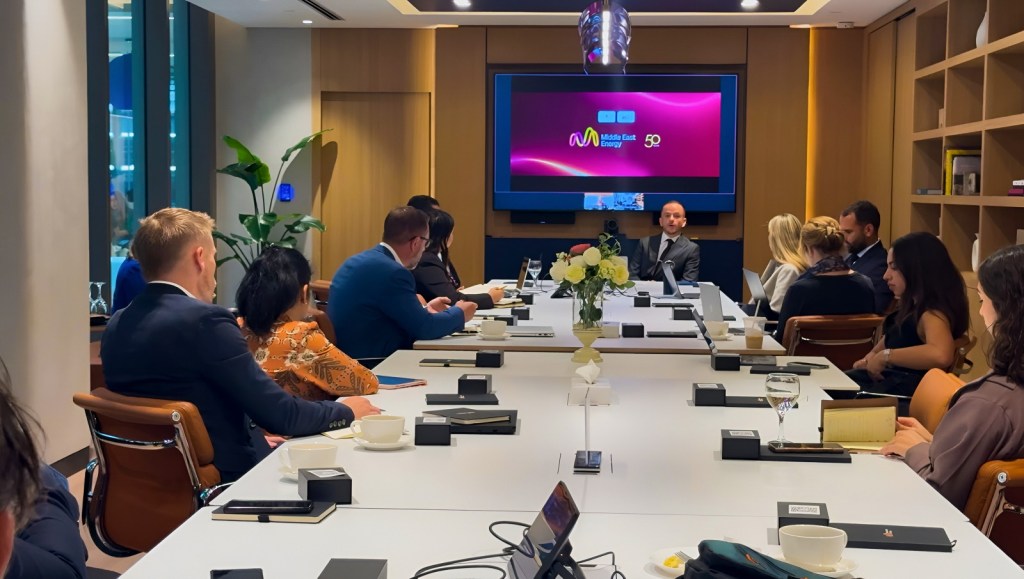
The session brought together media with the Middle East Energy team and knowledge partner, Rystad Energy, for an exclusive look at the significantly shifting global energy landscape ahead of the show’s September edition.
The event is expected to bring together more than 35,000 energy professionals from nearly 120 countries and over 1,500 exhibitors across the power generation, transmission and distribution, storage and energy efficiency sectors.
The briefing was presented by Middle East Energy Group Exhibition Director, Mark Ring, with Carlos Torres Diaz, Head of Power along with Aditya Saraswat – Head of Upstream Research MENA & Caspian from Rystad Energy, who spotlighted the key trends set to define the sector in Q3/Q4 and beyond.
The Middle East has emerged as a critical hub in the global energy transition, with countries across the region advancing ambitious initiatives to strengthen energy resilience, accelerate renewable adoption and integrate emerging technologies into existing infrastructure.
Against the backdrop of this fundamental transformation, Rystad forecasts that the region’s installed power capacity will quadruple from 580 gigawatts (GW) in 2025 to 2,328 GW by 2050.
The discussion highlighted a growing consensus that the sector’s next phase will be defined by three converging trends. Firstly, that power demand is entering a new growth era; MENA power demand is forecast to more than double, from 1,671 TWh in 2025 to 3,670 TWh by 2050. Crucially, this will not only be driven by traditional demand growth. Industry and residential will remain major consumers, while data centres, hydrogen, transport and commercial/public services add new layers of demand. In the UAE, electricity is set to rise from 17% of final energy demand in 2025 to 42% by 2050.
The response is a significant transformation of the power system; MENA installed capacity is likely to rise from 580 GW to 2,328 GW by 2050, with solar and wind taking an increasingly large role. In the UAE, solar is predicted to move from 11% of generation today to 50% by 2050, driving infrastructure around it: regional solar manufacturing is due to grow 7-fold by 2030, while battery storage will be required to accelerate rapidly.
Lastly, scale is changing how energy projects need to be delivered; the Middle East is becoming both a major energy investment market and a live testbed for how significant energy projects can be delivered effectively. With the project pipeline becoming larger and more complex, effectiveness is increasingly driven by effective asset utilisation, choosing quality contracts over sheer order-book volume, broadening capabilities through consolidation, and using strategic JVs that combine local knowledge, complementary skills and technology.
Carlos added that the convergence of AI, digitalisation and the energy transition is redefining what resilience means for the sector, with utilities and infrastructure operators now expected to deliver at a pace and scale that legacy systems were never built for. Rystad Energy’s outlook also points to a continued role for gas, alongside the rapid expansion of renewable energy and storage. The region’s energy transition is therefore expected to be characterised by diversification, balancing reliability, affordability, sustainability, and energy security.
“The Middle East is entering a period of significant expansion in its power system,” said Carlos Torres Diaz, Head of Power at Rystad Energy. “There’s a very big push towards renewable energy. At the same time, nuclear remains a viable source of supply, while gas also remains in the mix. Looking at what’s expected for the Middle East and Africa, we see that the region will become the third largest consuming region after Asia-Pacific and North America. As the Middle East region diversifies beyond oil and gas, power demand is set to double by 2050, with forecasts reaching 3,670 TWh, with data centres, commercial activity and public services contributing to this demand.”
At the centre of this transformation is the UAE, where strategic investments in clean energy, advanced digital infrastructure and smart grid technologies are reshaping the region’s energy ecosystem and creating new opportunities for global collaboration.
Aditya Saraswat – Head of Upstream Research MENA & Caspian said, “Especially in the UAE, it has been critical to highlight that the country has been playing both sides of the energy balance. It is ramping up supply alternatives, both conventional and alternative, to make sure that we move into an orderly energy transition. Secondly, it is also ensuring that domestic demand is flexible enough. It is a flexible energy system catering to diverse demand.”
With more than 210 speakers across five stages, Middle East Energy 2026 will place these developments at the centre of its conference programme, with discussions spanning AI and digitalisation, electricity demand, energy efficiency, grid infrastructure, storage, renewable energy and investment.
Mark Ring, Group Director, Middle East Energy said, “Representing the generation, transmission and distribution, storage and efficiency sectors across the entirety of the show has been central to what we do, and the outlook shared today showcases why convening the energy industry remains critical to delivering on rising demand. Middle East Energy is no longer only an industry exhibition. Alongside its core focus as a trade event for the industry, this year has seen growing presence from the investment sector, reflecting the increasing importance of the role of capital required to develop and modernise infrastructure. What we can see reflected in the 30,000+ attendee registrants for 2026 is that Middle East Energy will continue to be a global meeting point for trade, for investment and for advancing power infrastructure. This year’s speaker lineup, alongside our participants and exhibitors, reflects exactly that. Those conversations will certainly start on those stages, but they will continue onto the show floor and onto exhibitors’ stands.”
The event in September will also convene senior leaders from across government, utilities, developers, financiers and technology providers, reflecting the increasingly interconnected relationship between energy infrastructure and capital investment.
The 50th edition will also place a strong focus on the role of women in the energy sector through Powered by Her, a dedicated programme taking place on 3 September, in partnership with the UAE Ministry of Energy and Infrastructure.
The programme will officially launch at 10:00am at Al Multaqua Ballroom and will celebrate Emirati women and women across the wider energy industry who are helping shape the sector’s future. Other key moments across the three-day event include the Dubai Global Leaders session on 1 September, bringing together global leaders from the energy, climate and investment communities, and the Global Energy Efficiency Alliance Round Table, conceived at the World Governments Summit, and held at Middle East Energy 2026 on 2 September, hosted by the Ministry of Energy and Infrastructure and bringing together private-sector CEOs from the region and around the world.
Taking place from 1-3 September at Dubai World Trade Centre, the conversation on delivering for the demand of the future will continue at Middle East Energy 2026.
Registration is free of charge for Middle East Energy 2026, bringing together thousands of energy professionals, government representatives, investors and industry leaders from around the world. The 2026 edition is set to be key meeting point for the global energy community in a critical year, enabling stakeholders to explore emerging opportunities, understand how to deliver against demand, discover innovative solutions and build partnerships that will help shape the next generation of energy infrastructure.
About Middle East Energy
Middle East Energy is the region’s leading trade event for power infrastructure, bringing together decision-makers from across the energy industry to advance real-world projects. Held annually at the Dubai World Trade Centre, it combines a large-scale exhibition, five conferences and three co-located shows spanning transmission and distribution, renewables, storage and backup power. With more than 35,000 attendees and 1,900 exhibitors, it is where the global energy industry comes to do business
About Informa
Informa is a leading international group in B2B live events, digital services, and academic markets. The company empowers professionals by connecting businesses and individuals with the knowledge they need to learn, discover, and make informed decisions. Informa is listed on the FTSE 100 and employs approximately 14,000 people across more than 30 countries worldwide.
 Arab News 24/7